A Blog For The Farm Happenings And Whatever Else Strikes My Fancy.
Showing posts with label Clothes. Show all posts

Monday, 9 January 2017

Darn It! How to fix that hole in your favorite sock


Assuming you're a human being, you probably know this story as well as I do: The threads of  your favorite pair of socks have worn down and created a hole. You have continued to wear them with your big toe hanging out. Your dog has pointed it out to you with her wet nose. Your parents have begun to worry about you and your financial state. You try to ignore that cold spot inside your boots. You yank your socks off for what you believe to be the last time. You dangle them over the trash can. A tear rolls down your cheek. But wait! You favorite socks can be saved! 

Here is a simple tutorial on how to mend that hole to lengthen your sock's life expectancy. 


The basic idea of sock darning is to replace the material that has worn away and to reinforce the material that is still there. Essentially, what you'll be doing is weaving. There are multiple ways to darn, I will just be giving you one of the more basic techniques. 

NOTE: Keep in mind when you're looking at my pictures that I  should have made my initial cross threads closer together. I would suggest you make them closer, it will give you a tighter weave and, in the end, a more durable patch. 

What you'll need:
  • A sock with a hole in it 
  • A Darning Egg or a Darning Mushroom 
  • Darning needles or long, blunt craft needles that aren't too thick
  • and string, or a very small yarn, or embroidery floss (You want to make sure it's not too coarse, otherwise it wouldn't be very comfortable to wear after) 

 I wish that my egg was a little larger. It works fine, but if you're buying on new I would suggest you get something a little bigger. I think it would just be easier to work with. I also would not steer you away from a mushroom. I have never used one but I have heard good things about them from those who have.

Darning:

Step 1. Put the egg into your sock and line the hole up with the end of the egg. Hold the handle with your left hand (assuming you are a righty, reverse it if you are not) so that the sock is not bunched up on the egg. If you pull the sock too tighty your patch will be too big if it's too loose the patch will be too small. Make sure it's just tight enough around the egg that there isn't tension on the threads, but you can clearly see them all laid out. 

I have seen some people put a rubber band around the sock and egg to help hold it all in place while you work. I have not tried this but you certainly can if that sounds helpful to you. 

Step 2. Start by putting your needle in at one side of the hole and pulling it almost all the way through so that you leave a tail that's just a few inches long. Don't tie any knots yet. 

Even with a round hole you need to visualize it as if it were almost square. Keeping that in mind, start sewing across the hole so that there are threads laid out over the hole in a consistent pattern. Usually you can see that the threads right around the hold are beginning to wear out, keep your threads beyond that. Stitching into the material that is currently in good condition will help to reinforce the threads that are beginning to to show wear.

If you are familiar with weaving, this step is creating your warp.


Step 3. Once you have your warp laid out you will begin weaving. Start from which ever corner you ended the last step in and start stitching threads in the opposite direction. Go in an under-over-under-over pattern using the threads you just put there. at the end of each row, stitch into the sock to hold the threads in place. If there is sock material under where you are weaving stitch into it when you go "under." Incorporating that into the weave will make the patch stronger.


Every couple of rows, push the strings towards the end where you started weaving. You want the weave to be as tight as possible and the strings and stitches to be as close together as you can make them without them overlapping. 


Step 4. To finish you need the last stitch to be right beside where your first stitch was. If it is not, do one more weave across in the appropriate direction to make it so. Take the two ends of the string (The start string and the end string) and tie them together in a nice, tight knot. Cut the loose ends of the knot. 

At this point you can admire your handy work and congratulate yourself on giving your socks new life. Job Well done.  


 Now. The big question is: If you darn a sock so much that there is none of the original material left, is it still the same sock?


This tutorial has been shared in this link party! 

Over the Moon Link Party

Tuesday, 3 January 2017


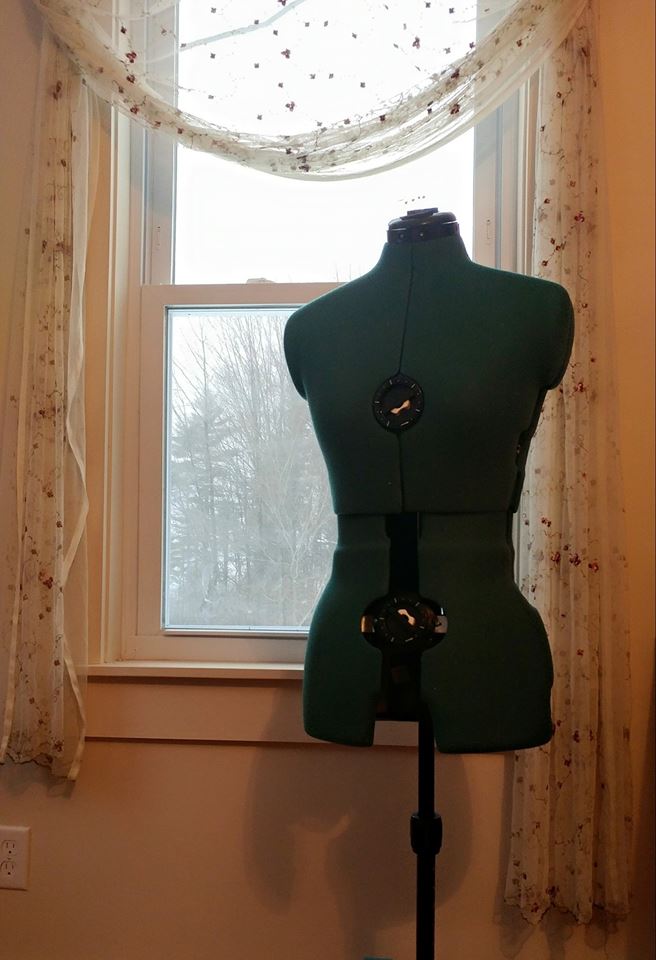
I am absolutely in love with the newest addition to my work space! I figured, seeing as how this marvelous dress form will be making frequent appearances in my blog posts, that she deserved her own introductory post. My brother informed me that I had to name her, to which I shouted the first name that came to mind, which just happened to be Giselle. I don't personally feel she needs to have a name, so I doubt it will stick, but you never know. This specific Dirtz dress form can be found HERE and it is one I would suggest. She's easily adjustable and seems durable. I do wish that you could pin into the surface, but I could either get one that was adjustable or pinnable, apparently you can't have both. And there you have it. Isn't she wonderful? 

Tuesday, 29 November 2016

Adding Pockets to a Skirt or Dress


I admit, going into this project I was pretty intimidated. I knew I wanted pockets, but I also knew that once I started there was no going back. And as I really liked the dress, failure was not an option. However, this came together so much more smoothly than I anticipated. I did get thinking halfway through that I should probably have gone off of someone else's tutorial for my first attempt. I did, basically, make this up as I went. Nonetheless,  I am quite satisfied with the final product and I see myself doing it just the same in the future. 
I realized an amazing aspect of adding your own pockets. They can be as big as you want them to be! Now, how many of you have pockets that won't even fit your hand? I know I do. And most skirts and dresses don't even have pockets! Anyway... I'm sure you've picked up on the fact that I'm pretty excited about this. 
So, the pockets in this tutorial I guess are what you would call Welt pockets. Maybe not, I don't know my pocket styles very well. I'm hoping to eventually do a side seam pocket, I feel that could be added to a wider variety of garments, as (hopefully) they wouldn't be seen unless your hands were in them. 

well... here goes, and god luck following my instructions. If you have any questions leave a comment, shoot me an email, send a carrier pigeon; I'll make sure to get back to you.  Also, I do appologize for the quality of the pictures - I feel I say that an awful lot. That's what I get for working on these things too far into the night. 

Also, keep in mind that your garment doesn't have to have two pockets. If getting two to match perfectly makes you faint-hearted just do one. 

Step One: I started by making the piece of fabric that will go over the pocket. The only bit you'll see from the outside. I happened to have some of the same material as the dress and used that, but if you don't have the exact same fabric, fret not. A complementing fabric would be fine. If you went with something contrasting I think that would look amazing. Perhaps a colorful print on a solid or, if the skirt is a busy print, you could go with something solid and bright. Don't be afraid to make the pockets pop!
My pockets are 5 inches long. I cut the material 6 inches and folded the ends over a half inch. As you can see in the picture below, the top of the strip is a clean hem and the bottom is a raw edge. The bottom will be sewn under, so it's okay if it's not pretty. Height-wise they are about an inch and a half, with a half inch or so of seam allowance on the bottom. The measurements for the height don't have to be too exact, as long as the two pieces match, the length definitely does have to be exact. 


Step 1
 Step Two:  Lay out your skirt and, being very precise with your measurements, determine where you want your pockets to be. If you are just doing one pocket this step isn't quite as vital. But if you'll be making two pockets you want to be sure they line up. How I did it was to measure across the waist to find the middle, measured down from the middle, determined how far apart the pockets should be, and pinned the inner pins accordingly. I then decided how steep and angle I wanted them to be at, pinned on side, measured down the side seams, then pinned the other side to match. You only need to pin each end of where the pocket slit will be.You can draw a line on the material to mark where the slit will be, rather than using pins, if you would prefer. Just make sure that however you are marking it that the slit will end up being an inch shorter than the piece you made in step one. That piece will need a half inch on either side to be attached later on.
note: Your pockets don't have to be at an angle as I did mine. They can be straight across.
Step 2
 Step Three: Cut your slit. simply use sharp sewing scissors to cut along the previously determined line. I did not have an actual line, I just cut straight from one pin to the other. You can do the same, or, if it makes you more comfortable, you can draw a line to go by.
Step 3
 Step Four:  Cut the pocket lining. You will need four individual, matching pieces. If your chosen fabric has a right side and a wrong side, be sure that two of them face the opposite direction than the other two. I used a contrasting yellow to go with my red skirt, but you can use whichever color you'd like so long as it's a light weight, stretchless material. If your pockets are going to be horizontally across your pocket linings will either be squares or rectangles depending on how deep you want your pockets. Mine are square on the bottom and at the top they match the angle of the slit. Another option would be to make your pockets rounded at the bottom. Make them however you'd like. Heck, give it star shaped pockets for all I care. Just be sure that the top is an inch or so wider than the slit. I was bad and didn't measure anything while making my linings. You can eyeball it as I did, I'm sure.
Step 4
 Step Five:  With right sides together pin the lining pieces to the top and bottom of the slit. Be certain that the angle is correct. if you lower the upper piece, do they line up and go in the direction you want them to? If not, adjust them accordingly. Also see that they go right up to the edge of the slit.
Step 5
 Step Six: Turn your dress/skirt inside-out and sew all the way around each slit, securing the lining in place. Sew fairly close to the edge. I would recommend a small zigzag stitch if either of the materials you are working with fray easily.
Step 6

Also Step 6
 Step Seven:  Pull the pocket lining pieces through the slit while the dress is still inside-out. pull them downward, into the position they will be when all is done. Line them up nicely. Pin them together if you so desire.
Step 7
 Step Eight: Sew the lining pieces together on the sides and bottom to create your pocket. You can skip this step if you would like to, but the final product will not hold your phone very well, and we all know that's why we really want pockets.
Step 8

Also Step 8
 Step Nine:  Now, pull the pockets upward and pin them in place. This is simply to keep them out of the way for step 10. Now turn the dress/skirt right-side-out.
Step 9
 Step Ten: With the pretty side down, place the little piece from step one just beneath the slit with that raw edge against the bottom of the slit. Sew it into place. Do just the same on each side.
Step 10
Step Eleven:  Once more, put the garment inside-out. Unpin the pockets and repin them in the downward position. Again, this is just to keep them out of the way so they don't accidentally get sewn where they don't belong. Turn it to be inside-in
Step 11


 Step Twelve: Fold the strips upward, to cover the slits. Iron Them flat if it seems necessary. Pin in place.
Step 12
 Step Thirteen: Fasten the piece down by sewing little rectangles on each end of it. I suppose it doesn't have to be in rectangles, it could just be lines, or zigzag lines if you like. I personally like little rectangles. As you stitch this down it may (probably will) sew the very edge of the lining just a tad. That's okay.
Step 13
 Voila.  You now have pockets. That wasn't to hard now was it? I'd love if you would share your project with me so I can see how this worked out for you.

Thanks for the visit to my blog! Leave a comment, let me know what you think.

Tuesday, 27 September 2016

Stripes!

Bad Lighting :/
Sorry! I have no tutorial for this one. I've just made this dress and I couldn't wait to share it. I'm loving it! It reminds me of some of the dresses that Maid Marian wears in the BBC Robin Hood series (An incredible show, by the way) 
To make the pattern I used a really simple vest pattern and basically just made it longer, as well as changing the neck line and the front/closure. I traced out the pattern onto the back of wrapping paper then added my changes. If you wanted something similar you could just use a vest pattern without changing anything but the length.
The red underskirt (as you can see in one of the photos) is not attached.  I did that so I could interchange what I wear under it if I want to. I thought I could wear a long sleeved shift with it, so the sleeves and skirt are the same color.  Or perhaps pants could be worn underneath so I could go ridding in it. That's a thought!
 I do think I am going to add some length to the underskirt (and maybe I'll iron it as well... that crease is not supposed to be there) now that I'm looking at the pictures I think I'd like it to be closer to the same length as the overdress.
I really love this, and I think I will love it even more this winter as an added layer when it gets cold. 
We can be warm And  stylish! 

And of course Lexie had to have part in the photo shoot!
She's such a cutie, how could I not make her a part of this?


3 yards for 3 dollars! SCORE
The pattern I used 


Thursday, 7 May 2015

Simple Dress Alteration


I got this dress at a thrift shop for a $1! I really liked the material, but it was too loose at my sides and too long (reached the floor!) I figured for a dollar I'd take it home and see what I could do. My first thought was that I would cut apart the material and make something entirely new, but instead I made some really basic alterations to make it just the way I wanted it. I'm super happy with the outcome and for anyone trying out something similar, this didn't require any special sewing gadgets or extra parts (I only used what came with the dress.) These alterations are so easy for anyone just getting into sewing... so don't be intimidated to chop up your clothes and alter them :) Just go for it.

My before picture is dark and not very clear, but I did remember to take one this time for a change.
My dress had a zipper down the back, which helped so I didn't have to worry about making it too tight, or taking out any of the stretch.
Before

My first step was to take in the sides. I turned it inside out and pinned just over an inch on each side, using the location of the seam that was already there. This measurement will vary depending on how loose the garment is. You can either pin it and try it on (Inside out) too see if you pinned enough/too much or you can put it on (Inside out) and pin it while you're wearing it. Having an assistant or a dress form could prove helpful for this step. If you're taking the dress in a lot I would cut off the extra material after you've sewn it. I didn't, just in case I ever want to let it back out. Though, honestly, I don't really foresee that happening. 
Pinned sides. 
Decide how long you want the skirt. You can measure the length, or put it on and make a mark, whatever is easiest for you. I cut my skirt approximately four inches higher than I wanted it, (You'll see why in a moment.)
 I cut the length using a rotary cutter, but scissors would do the job.
Cut the length

After it was cut I then cut a strip (Fourish inches) of the hem off and sewed it onto the bottom of the dress. The bottom of the skirt was wider than the top so I did have to make the strip just a hair smaller. Sewing on the hem like this adds to the style of the dress and makes it so you don't have to sew your own hem. It let's it keep that 'store bought' appearance, if you're not terribly good at hemming.


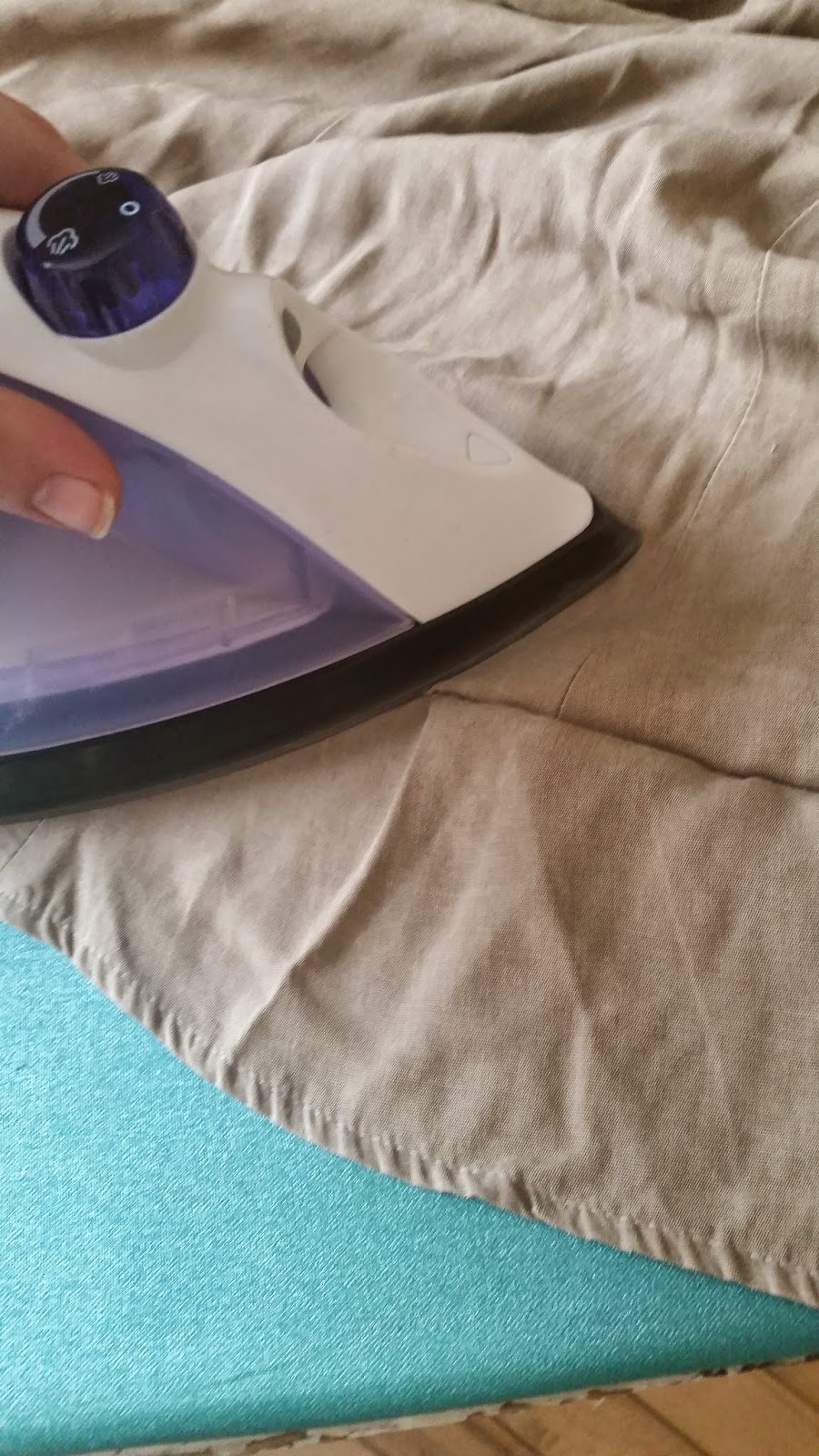
You can iron the knew seam flat, and you are good to go.


Tuesday, 5 November 2013

Half Cape

I've had a table cloth mom gave me that I had planned to make a cape with, and I also just bought some pretty curtain like material  at Savers. I found this amazing pattern on line here. I made two capes out of two very different fabrics, an over cape and an under cape. But they can be worn by them selves because they aren't attached. The top one is more elegant,  with a fancier clasp.  The under cape is much more rustic and woodsman looking. 
both
top

Monday, 26 March 2012

Faye's new Scottish Attire

We went to IKEA in Massachusetts while visiting my grandmother, they had a stuffed dog and to go with it you could buy clothes for 99 cents each... I took one look at them and said to my self "Goat Clothes!" So here's Faye in her new stylin' Scottish clothes!